
Light Blue Crystal Identification: Photo Clues and Common Matches
Compare visible clues for light blue crystal names, including color, luster, transparency, matrix, common matches, and when to verify with a specialist.
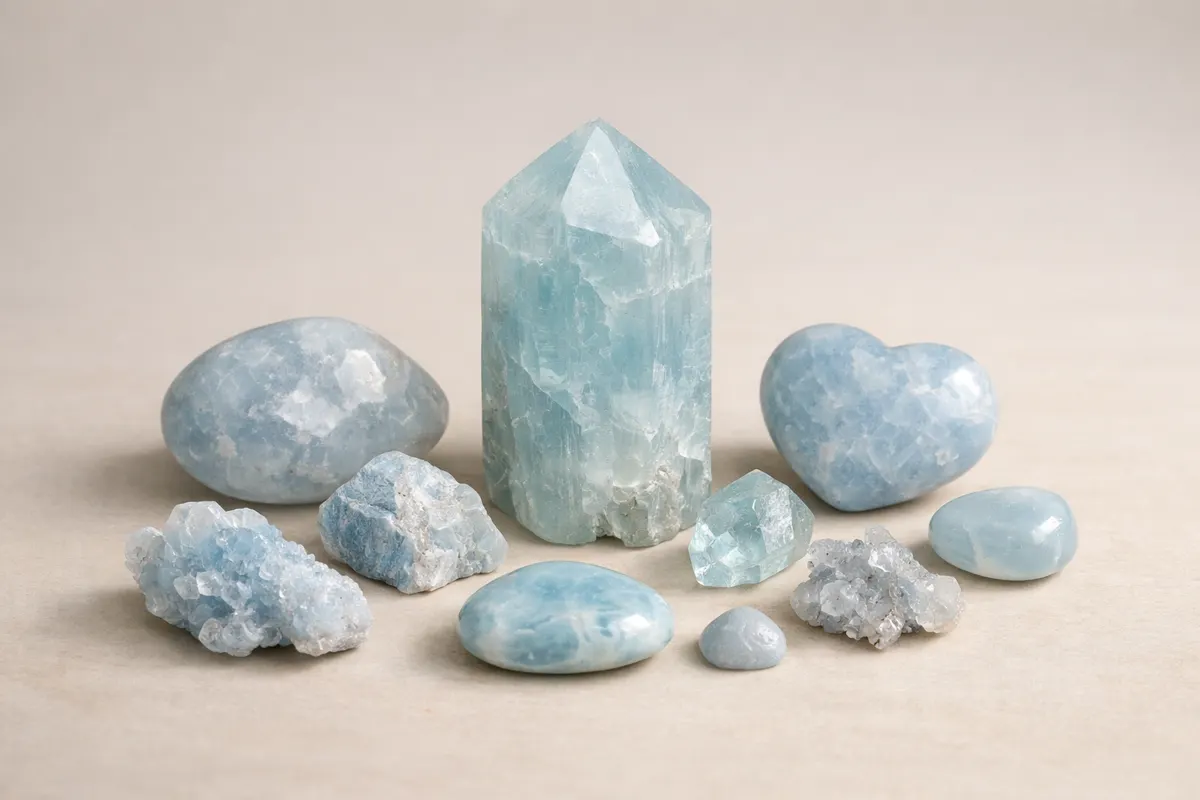
Quick answer for light blue crystal names
When you want to narrow down light blue crystal names from a photo, focus first on four robust, camera-friendly clues: transparency (transparent → translucent → opaque), surface luster (glassy/vitreous, silky, waxy, or pearly), crystal habit or texture (well-formed prisms, banding, fibrous, granular), and the matrix or host rock (veining, brown host, or sedimentary matrix). These clues survive many lighting and phone-camera limitations better than hue alone.
In practice, a clear, hexagonal prism that’s glassy and transparent points toward beryl family stones like aquamarine (higher confidence). A waxy, banded translucent piece with smooth curved surfaces suggests chalcedony or blue lace agate (medium confidence). An opaque, chalky stone with brown veining and a softer feel is more likely turquoise or howlite that’s been dyed (lower photographic confidence until you check hardness and matrix).
Use these visual clues together rather than one at a time. Color narrows your match list; transparency, luster, habit, and matrix raise or lower your confidence. After you compare these clues, scan the stone with the Stone Identifier app as a first-pass tool, and pursue lab or expert verification for anything with financial, health, or legal consequences.
Strongest visual clues
These are the properties that most consistently translate from hand sample to photograph and that separate common light-blue minerals and gemstones:
1) Transparency and translucency. Photographs show whether light passes through the stone. Transparent stones (clear through the material) are strong candidates for gemstones like aquamarine (beryl) or blue topaz. Translucent-but-not-clear stones—foggy or glowing at the edges—often indicate microcrystalline quartz (chalcedony variants) or some varieties of fluorite. Opaque stones point toward turquoise, larimar, or certain altered minerals.
2) Luster. Luster is the way a surface reflects light and remains one of the most diagnostic photographic clues. A glassy (vitreous) luster with sharp, bright reflections fits well with transparent beryl or topaz. A silky or pearly sheen and a fibrous texture often indicate pectolite/larimar or some zeolites. A waxy, dull sheen suggests chalcedony or nephrite-like microtextures. Pearly on cleavage faces can point to celestine or blue calcite.
3) Crystal habit, cleavage, and fracture. Look for habit clues your camera can capture: hexagonal prisms or striated faces for beryl (aquamarine); tabular or bladed forms for celestine/celestite; cubic cleavage and blocky break for fluorite; fibrous or radiating textures for larimar/pectolite; and banding for agates. Cleavage planes that reflect light evenly are a clue to minerals like topaz (distinct cleavage) versus fracture patterns seen in chalcedony.
4) Matrix and veining. The host rock or matrix and any brown/black veining are especially useful. Turquoise often appears with dark brown limonite matrix or brown host rock; larimar typically shows white veins and clouding; blue lace agate displays layered banding with distinct white bands; marine sediment-hosted minerals like celestine may preserve surrounding gypsum or chalky matrix. Matrix is a durable clue—if you can photograph the underside or edges including attached host rock, it dramatically raises confidence.
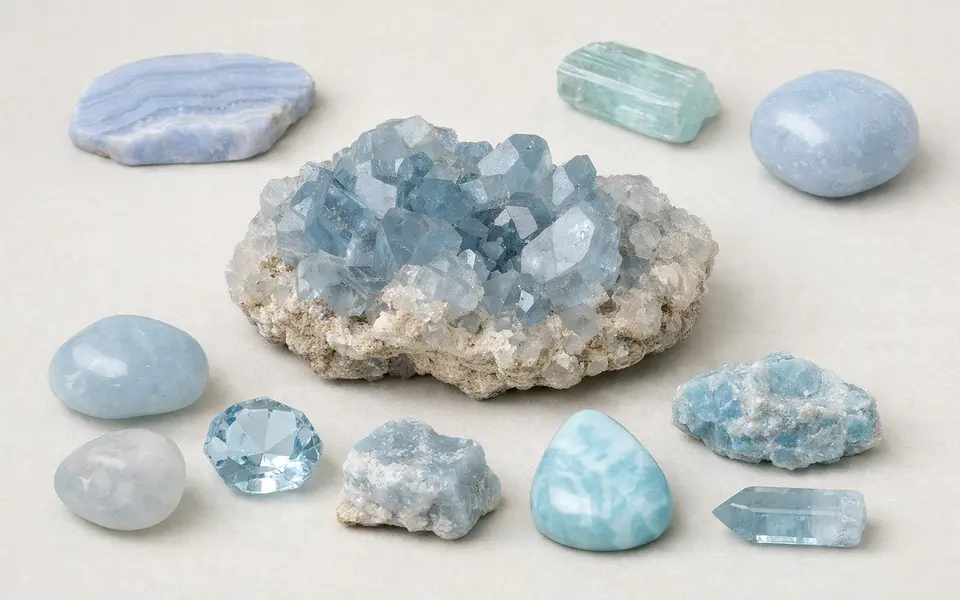
- Transparency (transparent vs translucent vs opaque) — high photographic reliability
- Luster (vitreous, silky, waxy, pearly) — high reliability
- Crystal habit/texture (prismatic, tabular, fibrous, banded) — medium–high reliability
- Matrix or host rock (veins, brown matrix, sedimentary hosts) — high reliability when visible
Weak signals
Color alone is a weak signal for light blue crystal identification. Camera white balance, ambient lighting, reflections from clothing or sky, and artificial tinting from polishing agents or dyes can move a stone from pale sky blue to green-blue or a deeper blue in a single photo. Treat hue as a narrowing filter, not a diagnosis.
Surface glare and single-angle photos are common pitfalls. A glossy surface will reflect light sources; that reflection may hide texture, hide banding, and misrepresent the stone’s color. Likewise, one close-up that only shows a polished face can disguise porosity, matrix, or crystal habit. Multiple angles and diffuse lighting reduce these errors.
Other weak indicators: size estimates from a photo usually mislead unless you include a scale; camera compression can exaggerate transparency; and polished cabochons or treated stones can mimic more expensive materials. Avoid relying on smartphone EXIF or filter effects—turn off filters and photograph under neutral light when possible.
- Hue and saturation alone — unreliable without other clues
- Single-angle, high-glare photos — hide surface texture and matrix
- Scale without a reference — leads to size misestimation
- Polishing, dyeing, and treatments — can imitate more valuable stones
Comparison workflow
Follow this stepwise workflow to compare a photographed light blue stone against common matches. Use each step to raise or lower confidence and to decide whether to test further in-hand or consult an expert.
Step 1 — Note transparency and luster. Take or choose a photo that shows the edge and a backlit view if possible. Transparent + vitreous = beryl (aquamarine) or topaz (higher chance of being a gem). Translucent + waxy = chalcedony family (blue chalcedony, blue lace agate). Opaque + chalky or granular = turquoise, howlite, or altered minerals.
Step 2 — Inspect habit and texture. Does the stone show hexagonal prism faces, cubic cleavage, tabular plates, fibrous interiors, or banding? Examples: aquamarine (beryl) commonly displays hexagonal prismatic crystals and relatively clean, sharp faces; fluorite tends to break into cubic shapes; celestine often forms tabular or bladed crystals with a pearly sheen; larimar shows a soft, almost cloud-like fibrous texture with white veins.
Step 3 — Look for matrix and veining. Photograph the underside or the stone edge where the host rock is still attached. Brown, iron-stained matrix with angular pockets favors turquoise or some altered copper minerals. White, chalky matrix or sedimentary hosting suggests celestine or marine secondary minerals. Distinct banding points toward chalcedony/agate families.
Step 4 — Use small, non-destructive checks if you have the specimen in hand. A simple hardness comparison (scratch testing against a known item like a steel blade or glass) gives broad separation—calcite and turquoise are soft (<5), beryl and topaz are harder (>7). But avoid destructive testing on pieces that might have value; when in doubt, stop and seek a lab. Combine these in-hand checks with photographic clues to reach a working ID.
Step 5 — Example matches and the combination of clues that point to them:
- Aquamarine (beryl): transparent to translucent, vitreous luster, hexagonal prismatic habit, hardness ~7.5–8. Photo clues: clear edges, bright reflections, pale sky-blue color without banding. Confidence: medium–high from photos when habit and transparency are visible.
- Blue chalcedony / blue lace agate: translucent to opaque, waxy to vitreous luster, banded or massive texture, common banding with white. Photo clues: soft glow under backlight, visible banding or flow lines. Confidence: medium from photos; banding raises confidence.
- Larimar (pectolite variety): opaque to translucent, silky sheen, fibrous texture with white streaks or clouds, often oceanic light-blue. Photo clues: clouded patterns and white veins, soft silky reflections. Confidence: medium from photos, higher with visible fibrous texture and matrix.
- Turquoise: opaque, waxy to dull luster, often with brown/black matrix, relatively soft. Photo clues: uniform opaque blue with brown veining and chalky surface. Confidence: medium; matrix strongly supports ID.
- Celestine (celestite): pale sky-blue, tabular or bladed crystals, pearly luster on cleavage, softer (~3–3.5). Photo clues: delicate tabular crystals or clusters with pearly faces. Confidence: medium when crystal habit visible.
- Blue fluorite: can be light blue and transparent to translucent, cubic cleavage, glassy luster, often fluorescent under UV. Photo clues: cubic faces, color zoning, and good cleavage; fluorescence (if you can test) is a strong confirmatory clue. Confidence: medium–high with habit and UV test.
- Step 1: Start with transparency and luster — take an edge or backlit photo
- Step 2: Check habit/texture — prismatic vs. fibrous vs. banded vs. cubic
- Step 3: Photograph matrix/edges for host-rock clues
- Step 4: Use non-destructive hardness or UV checks only when safe
- Step 5: Match compound clues to candidate minerals (examples above)
App workflow
Once you’ve run the visual checklist, use the Stone Identifier app as a structured first pass. The app can compare your photos to reference images and suggest likely matches, but treat its suggestion as a hypothesis to confirm, not a final identification.
Best practice: capture 4 photos before scanning—(1) an overall contextual shot showing size/setting (with a scale like a coin), (2) a close-up of the surface to show luster and texture, (3) an edge or backlit shot to reveal transparency, and (4) a photo of any matrix or attachment to host rock. Open the app and scan the stone using these images in that order if the app workflow allows multiple views.
After scanning, interpret the app’s top matches against the visual clues you collected. If the app suggests a high-value mineral (beryl, topaz, turquoise with rarity indicators) or if the identification affects health, safety, or money, follow up with in-person testing or a professional gemological lab. The app is a fast triage tool; verification is required for consequential decisions.
- Collect 4 photos: context/scale, surface close-up, edge/backlit, matrix
- Scan in the app as a first pass; use its suggestions as hypotheses
- Verify important or high-value IDs with a lab or qualified expert
Related guides
Scan after comparing stone clues
Use Stone Identifier after you photograph color, luster, transparency, edges, and matrix. Treat the result as a shortlist, then use hardness, UV, lab, or seller documentation when value or safety depends on the ID.
Take the next step →Frequently asked questions
Can I identify a light blue crystal from a single photo?
A single photo can narrow possibilities but rarely gives a definitive identification. Use multiple photos showing transparency, luster, texture, and matrix for a stronger tentative ID. When the outcome matters financially or for safety, treat a photo-based ID as provisional and seek in-person testing.
Which photo angles are most helpful for blue gemstone identification?
Take an overall contextual shot (with scale), a close-up showing surface luster, an edge or backlit shot to reveal transparency, and a photo of any matrix or underside. These four views capture the strongest clues that survive camera variations.
How do I tell the difference between aquamarine and blue topaz in photos?
Look for crystal habit and clarity: aquamarine (beryl) commonly forms hexagonal prisms and keeps a slightly oily vitreous sheen, while natural blue topaz often appears clearer with sharp cleavage reflections. Hardness and refractive properties require in-hand testing; photographically, habit and internal zoning give the best clues.
What signs suggest a light blue stone might be dyed or treated?
Uniform, intense color across porous areas, especially in stones that normally show matrix or banding, suggests dye. Sudden color concentration near pits or fractures, unusually bright color on an otherwise chalky surface, or mismatched color between fracture interiors and the surface are red flags. Treatments are common, so treat photo-only claims with caution.