
Pink Crystal Identification: Photo Clues for Rose Quartz, Rhodonite, and Similar Stones
Compare pink crystals and gemstones from visible clues with practical photo clues, comparison steps, limits, and verification guidance for pink crystal names.
Quick answer for pink crystal names
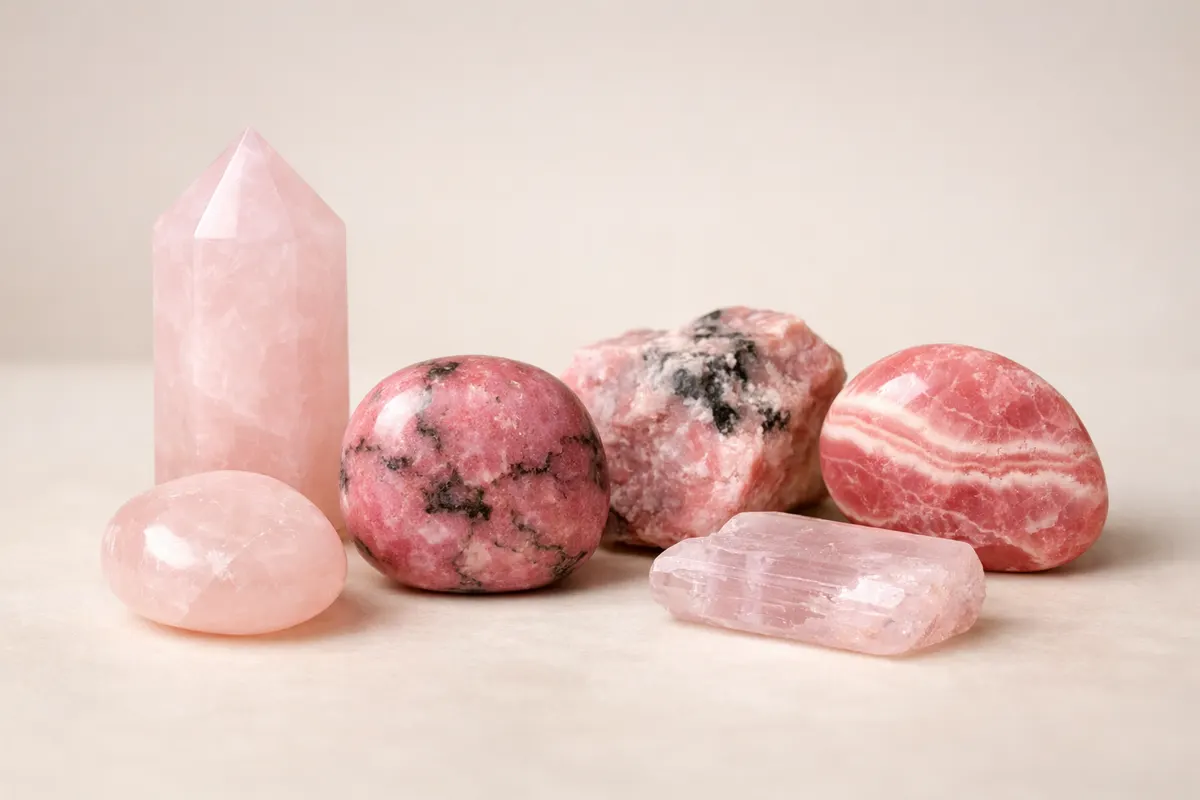
When you need to narrow down pink crystal names from a photo, prioritize clues that survive changes in lighting and camera settings: translucency (is the stone glassy, milky, or opaque?), internal texture and inclusions (fine needles, sugar-like grains, or banded layers?), and surface features (polish, fracture patterns, or black manganese spots). These traits are more reliable than hue alone because phone cameras and lighting can make many minerals look rosy.
Common quick matches: rose quartz typically appears milky to translucent with a soft, even pink and a glassy to greasy luster; rhodonite usually shows a deeper rose to salmon color with black manganese oxide veins or spots and a more blocky, opaque look; rhodochrosite often presents banded pink and white layers and a waxy to pearly luster; kunzite and pink tourmaline are clearer, more saturated, often transparent-to-translucent gemmy crystals. Use these patterns as initial hypotheses, not final IDs.
Do not conclude treatment, dyeing, value, or authenticity from a single photo. Visible clues can point you toward likely pink gemstone names and what tests to run next (hardness, specific gravity, polarized light, or lab reports), but they cannot prove those qualities alone. The checklist below helps you organize a photo-based comparison and decide when to use the Stone Identifier - Gemalyze app as a first-pass scan.
Strongest visual clues
The most stable clues for pink crystal identification are translucency, internal texture/inclusions, banding or veining, and surface finish. These survive typical phone-photo issues like white balance shifts or small exposure changes better than exact color or saturation. Look at the stone at multiple scales: the whole stone for banding/veins, mid-range for grain and pleochroism hints, and macro (crop) for inclusions and surface patterning.
Translucency: Rose quartz typically shows a diffuse, even glow—often called 'milky' or 'cloudy'—when held to light. Gem-quality kunzite, pink tourmaline, or morganite look more transparent and gemmy. Rhodochrosite commonly shows translucent-to-opaque banded layers with soft boundaries between pink and white. If the stone is fully opaque and granular, think rhodonite, rhodochrosite, or pink calcite.
Inclusions and internal texture: Needle-like inclusions (rutile) can indicate rose quartz (silky, chatoyant specimens) or tourmaline/kunzite if seen as isolated crystals. Black manganese oxide or black veinlets strongly suggest rhodonite. Sugar-like granular textures point to rhodochrosite or pink calcite. Parallel fibrous textures or scaly mica glitter suggests lepidolite or tourmaline-hosted mica.
Banding and veining: Clear, rounded banding of pink and white is a hallmark of rhodochrosite; sharp black veins cutting through pink are typical of rhodonite with manganese staining. Zoning or color banding within a transparent crystal (subtle color zones) can be present in kunzite or tourmaline; these are different from the layered bands of rhodochrosite.
Surface finish and fracture: Observe whether the specimen has a vitreous (glassy) sheen, waxy or pearly sheen, or an earthy/matte finish. Rose quartz and tourmaline have a glassy-to-greasy luster; rhodochrosite and calcite are more waxy to pearly. A conchoidal fracture or glassy chip likely points to quartz-family material; blocky cleavage and stepped surfaces suggest rhodonite.
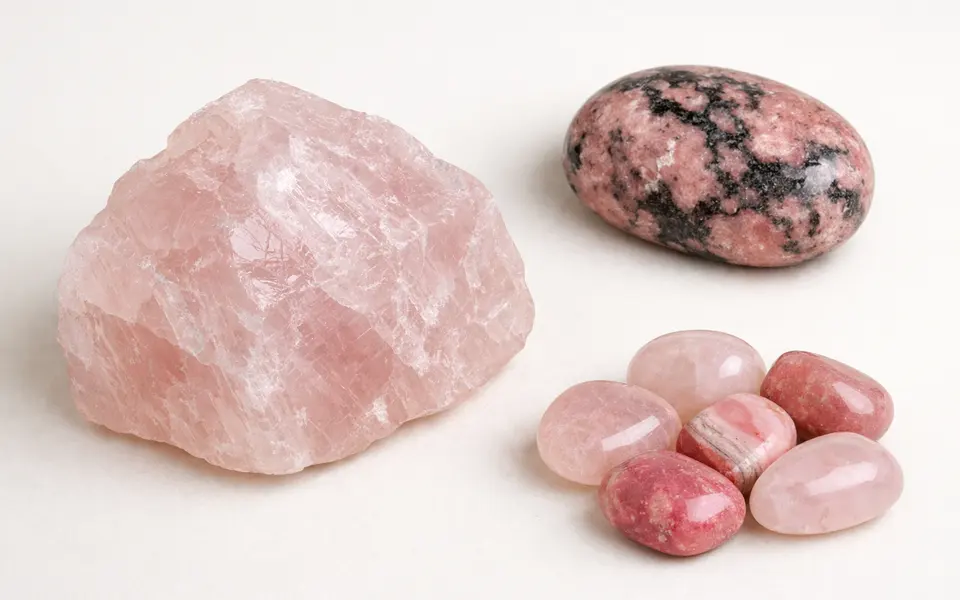
- Translucency: Transparent (kunzite, tourmaline) vs. translucent/milky (rose quartz) vs. opaque (rhodonite, pink opal).
- Internal texture: Needle-like rutile or silk (rose quartz) vs. granular 'sugar' texture (rhodochrosite) vs. mica sparkle (lepidolite).
- Veining/banding: Black manganese veins (rhodonite) vs. pink/white concentric banding (rhodochrosite) vs. clear zoning in gem crystals (kunzite, tourmaline).
- Luster and fracture: Vitreous/glassy (quartz, tourmaline) vs. waxy/pearly (rhodochrosite, calcite) vs. dull/earthy (pink chalcedony/opal).
Weak signals
Color name alone is a weak signal for pink crystal names because many minerals and treated stones can share nearly identical hues. A camera under incandescent light will warm pinks; fluorescent light can make them appear cooler or washed out. Saturation and hue should be secondary to the structural clues listed above.
Surface reflections, glare, and polish can obscure true texture. A heavily polished or tumbled stone hides cleavage, fracture, and surface microstructure that would be visible on an unpolished face. Similarly, dye or surface coatings produce an overly uniform color—if you see unnaturally saturated, perfectly even pink across porous or granular material, suspect treatment but don't assert it from the photo alone.
Scale and context: Small cabochons, beads, and cut gems can look identical in a photo while being completely different materials (e.g., dyed agate vs. rose quartz cab). A reference object—coin, ruler, or a thumb—helps establish grain size and whether features like banding are fine or broad. Without scale, textures like 'sugary' can be misread as fine vs. coarse.
One-angle photos are another weak signal. Planar features like cleavage or distinct crystal faces require side and edge views to confirm. If you only have a top-down shot, mark the ID as tentative and seek additional views or tests.
Comparison workflow
Use a stepwise checklist to move from broad groups to specific pink crystal names. First, decide transparency: is it transparent/gemmy, translucent/cloudy, or opaque? This single decision eliminates many possibilities. Transparent examples (kunzite, pink tourmaline, morganite) tend to show gemmy surfaces with sharp facet reflections or smooth crystal faces. Translucent/opaque examples (rose quartz, rhodonite, rhodochrosite, pink calcite) show diffuse light and less sharp reflection.
Second, inspect internal texture and inclusions at high crop. Needle-like silk or rutile suggests quartz family (rose quartz) or specific gem crystals; black spots or veinlets indicate manganese oxides (rhodonite). Concentric pink-and-white banding points strongly to rhodochrosite. If you see mica flakes or sparkly scaly sheen, include lepidolite or tourmaline-hosted mica in your shortlist.
Third, check luster and fracture. A conchoidal glassy chip favors quartz and gem silicates. Step-like cleavage, flat cleavage planes, or blocky breaks narrow toward rhodonite and calcite. A waxy or pearly sheen coupled with banding is a strong combined signal for rhodochrosite rather than rose quartz.
Finally, combine context with simple field checks (when safe and available): a soft scratch test on an inconspicuous edge can separate calcite (softer, effervesces with dilute acid) from quartz (harder, resists scratching). Use these physical checks only when you can do them safely and without damaging a specimen of potential value; otherwise, add the object to a list for professional testing.
- Step 1 — Transparency triage: transparent vs. translucent vs. opaque.
- Step 2 — Inclusions & texture: needles, sugar grain, black veins, mica.
- Step 3 — Luster & fracture: vitreous/glassy vs. waxy/pearly vs. dull.
- Step 4 — Small field checks or lab referral: non-destructive observations, hardness when appropriate, and referral for gem testing if needed.
App workflow
After you use the checklist above, open Stone Identifier - Gemalyze on your iOS device as a first-pass scan. Start by photographing the stone in natural daylight without direct sun (overcast or shaded daylight is best). Include one photo showing the whole stone with a size reference, one side/edge view, and one close-up crop showing internal texture or inclusions.
Use the app scan results as probabilistic suggestions, not definitive answers. The app can highlight likely matches (for example: rose quartz, rhodonite, rhodochrosite, kunzite) based on the image features, but combine that output with the visual-clue checklist above. If the app suggests a gem that conflicts with multiple strong clues (for example, the app suggests transparent kunzite but your specimen is opaque and has black manganese veins), trust the photographic evidence and collect more photos or tests.
If the app narrows candidates to a short list, plan your next verification steps. For lapidary-grade or jewelry items, ask for gemological testing (refractive index, specific gravity, spectroscopy) from a qualified lab. For specimens and rough material, consider a controlled hardness test, a streak test (for minerals where streak is diagnostic), or an expert field appraisal. Use the app to document your hypothesis and images before sending items for further testing.
Related guides
Run a first-pass scan after checking visible clues
Once you’ve used the checklist—transparency, inclusions, banding, and luster—open Stone Identifier - Gemalyze on your iOS device to scan the stone as a first-pass. Capture a whole-stone view with a size reference, an edge shot, and a close-up of internal texture. Treat the app’s suggestions as hypotheses to guide further testing or expert referral; do not treat a scan as final proof of treatment, value, or authenticity.
Take the next step →Frequently asked questions
Can I tell if a pink stone is dyed from a photo?
You can't reliably prove dye or treatment from a single photo. Clues that suggest possible dyeing include overly uniform saturation on porous surfaces, visible dye concentration in cracks or drill holes, and color that looks unnaturally vivid compared to the stone's texture. These are suspicion flags, not proof; lab testing or solvent tests are needed to confirm treatments.
How do I tell rose quartz from rhodonite in photos?
Look for translucency and matrix/veins. Rose quartz tends to be translucent to milky with a diffuse, even pink and a glassy-to-greasy luster. Rhodonite is usually more opaque, with a deeper rose to salmon tone often crossed by black manganese oxide veins or patches. If you see banding with white layers, consider rhodochrosite instead.
Is a clear, saturated pink stone likely to be kunzite or pink tourmaline?
Transparent, highly saturated, facetable-looking pink stones point toward gem crystals like kunzite, pink tourmaline, or morganite. Use clues such as pleochroism (color change from different angles), perfect cleavage (kunzite shows cleavage), or strong linear inclusions (tourmaline) to differentiate them. These distinctions often require multiple angled photos or in-hand examination.
What photos should I take to improve identification?
Take at least three views: a whole-stone shot with a size reference, an edge or side view to show thickness and cleavage, and a close-up crop of internal texture or surface details (inclusions, banding, veins). Use natural shaded light, avoid flash glare, and include a neutral reference (white paper or grey card) if possible.