
Is This a Fossil? How to Tell from Photos and Field Clues
Check a possible fossil rock for repeated patterns, impressions and geological context. Compare mineral lookalikes and collect useful photos for verification.
Quick answer: is this a fossil?
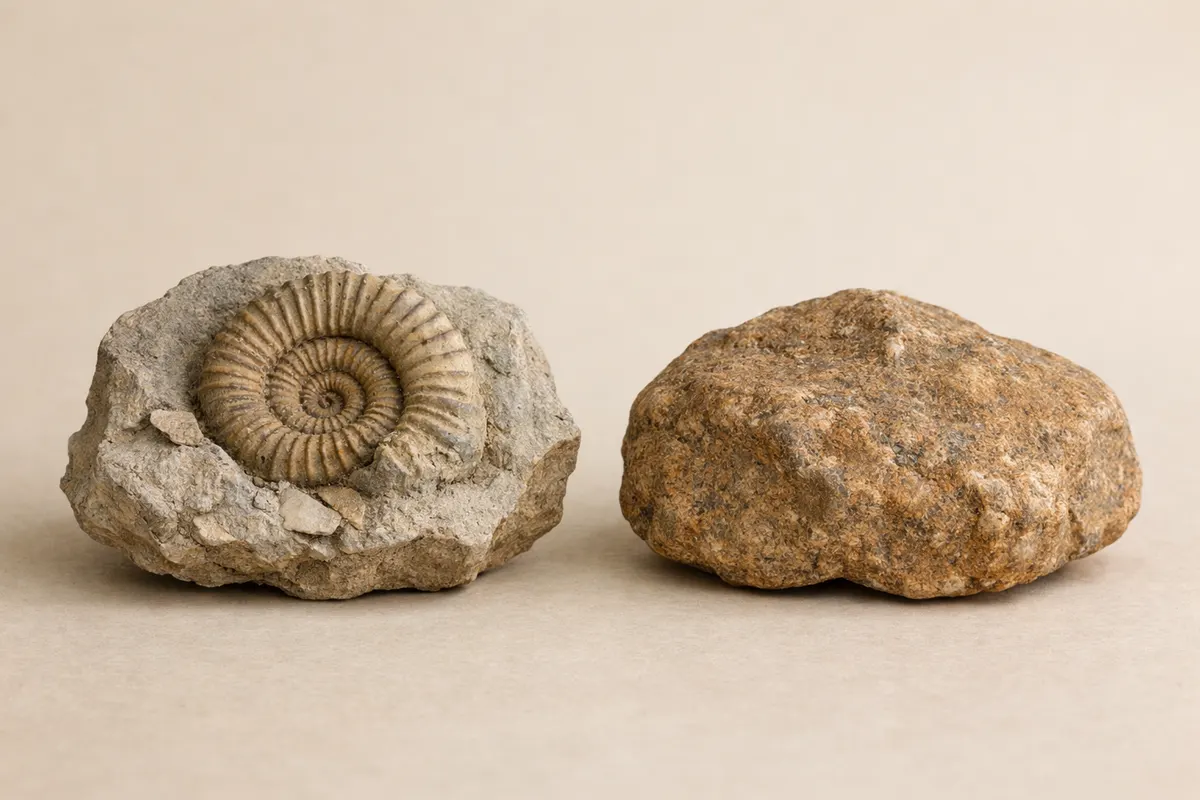
Short answer: sometimes. A photograph can show many of the visual clues that point to a fossil — repeated patterns, shell-like curves, segmented or symmetrical shapes, impressions in sedimentary rock, or texture contrasts between a hard fossil and its softer matrix — but photos alone rarely prove a fossil beyond doubt.
In practical terms, treat a photo as a strong lead, not a final appraisal. If the object shows clear, repeatable structures that match common fossil types (for example the spiral whorl and suture lines of an ammonite, or the ribbing and hinge of a bivalve shell), confidence can be high. If the image only shows a rounded pebble, a crystalline interior, or ambiguous pitting, the same appearance may be caused by mineral nodules, concretions, or weathered rock.
Use the photo to guide the next steps: capture multiple views, note the rock type and exact location, check for nearby associated fossils or bedding, and perform non-destructive field checks. Those additional data often change an uncertain photo ID into a useful, higher-confidence identification.
What “is this a fossil” really asks
When someone asks “is this a fossil,” they are usually trying to decide whether an object is a preserved remnant or trace of a once-living organism rather than a purely mineral feature. Fossils include actual hard parts (bone, shell, teeth), impressions (leaf or skin prints), and trace fossils (burrows, tracks, coprolites). Each type leaves different visual signatures.
Not every rock with a pattern is biological. Geological processes create lookalikes: mineral growth, root casts, concretions, gas-escape textures, and concretionary septaria can resemble shells, bones, or plant impressions. The difference often lies in repetition, symmetry, and context — fossils typically repeat consistent anatomical features and occur within sedimentary layers, whereas mineral textures obey crystalline geometry or random concretion growth.
A correct read therefore combines morphology, composition, and geological context. Morphology answers “does it look anatomical?” Composition asks “does it have different material or hardness than the surrounding rock?” Context asks “is it in a depositional rock or the right horizon for fossils?” Photographs can capture morphology well and sometimes composition cues; context usually requires on-site notes or multiple images showing surrounding bedding and position.
Key clues to check when asking “is this a fossil”
Focus your initial assessment on a handful of high-value visual cues. These clues are quick to check in a photo or on the rock: pattern repetition, abrupt change in texture at an edge, presence of symmetrical or segmented forms, and whether the object lies in a sedimentary layer.
Look at the surface and the broken edge (if visible). A genuine fossil often shows continuous anatomical features across the surface and into a fracture plane: layered shell cross-sections, internal canals in bone, or the consistent venation of a leaf imprint. Mineral nodules often show a homogeneous composition or radial crystalline patterns when broken.
Context clues are powerful. Fossils are most commonly found in sedimentary rocks such as shale, limestone, and sandstone. If the specimen sits in a volcanic deposit, fresh lava, or deeply metamorphosed rock, biological origin is less likely. Also note nearby finds: multiple similar shapes clustered in bedding planes increase confidence that the forms are biological rather than isolated mineral quirks.
- Repetition & symmetry: repeated ribs, segments, or bilateral symmetry suggest anatomy (e.g., brachiopod valves or trilobite segments).
- Texture contrast: a smoother or denser fossil in a softer matrix often stands out at the edge or under small fractures.
- Impression details: clear vein patterns on a leaf or fine growth lines on shell margins are diagnostic.
- Cross-section hints: layered shell material, internal cavities, or bone-like porosity visible in a broken face are strong indicators.
- Matrix & rock type: fossils are overwhelmingly in sedimentary rocks (shale, limestone, sandstone); crystalline igneous rocks usually indicate mineral origins.
- Associated fossils: nearby shells, plant fragments, or microfossil residue raise the odds significantly.
Step-by-step workflow to evaluate a possible fossil
Do this checklist as a non-destructive first pass. Work visually and with simple, reversible checks. Start by photographing the specimen from multiple angles: top, sides, and any broken faces or impressions. Include a ruler or coin for scale and wide shots that show the surrounding rock and bedding orientation.
Note and record the location and rock type. If you collected the specimen, write down GPS or map coordinates and the geological setting (stream bank, quarry, seafloor deposits, glacial till). If you did not collect it, record enough detail so a specialist can relocate the find or judge its context from your photos.
Perform controlled, non-destructive field checks: trace a fingernail or a copper coin gently across a weathered spot to get a feel for relative hardness, use a small magnet to rule out strongly magnetic minerals, and try a soft brush or water to reveal hidden textures. Avoid chiseling or hammering unless you have permission and the right skills — destructive sampling can remove key evidence and may be illegal.
- Photograph: 3–6 images (scale and context shots included).
- Record: date, exact spot, rock type, nearby features.
- Visual tests: symmetry, repetition, surface details, matrix contrast.
- Non-destructive checks: magnet test, gentle hardness feel, brushing to clear sediment.
- Compare: match your images to reference photos of common fossil types (shells, corals, trace fossils, plant impressions).
- Next step: if still unsure, contact a local university, museum, or a reputable online guide with your photos and notes.
Practical examples that answer “is this a fossil”
Example 1 — Spiral whorl in sandstone: A photo shows a tight spiral with fine ribbing and a smooth inner curve embedded in layered sandstone. The ribs follow the spiral consistently and depth of the impression is uniform. Interpretation: strong fossil candidate (likely gastropod or ammonite fragment) because of the repeated rib pattern and consistent curvature.
Example 2 — Rounded dark nodule with crystalline center: The specimen is a nearly spherical nodule with a sparkly interior and no repeated anatomical pattern. The exterior is pitted but shows no symmetry and breaks into crystal-like faces. Interpretation: not a fossil; likely a geode or concretion with crystalline growth.
Example 3 — Leaf-shaped impression on shale: A flat shard shows a narrow, serrated margin and a central vein with branching secondary veins that repeat along its length. The impression sits on a bedding plane with other plant fragments nearby. Interpretation: high-confidence plant fossil — leaf or fern impression, supported by context and anatomical venation.
Example 4 — Cylindrical burrow trace in fine siltstone: A linear, tubular structure crosses bedding with smooth walls and consistent diameter; no internal symmetry. Interpretation: likely a trace fossil (burrow or feeding trace). Trace fossils are biological but record behavior rather than body parts — useful, but different from identifying species.
- Spiral + ribs + sedimentary setting → likely shell fossil.
- Spherical sparkle + crystal faces → likely geode/concretion.
- Veined impression on shale → leaf or plant impression fossil.
- Linear tubular feature in bedding → trace fossil (behavioral).
Limitations
Photos have clear limits. Lighting, angle, and image resolution can hide or exaggerate features. Weathering and mineral replacement can make bone look like rock, and minerals can mimic biological textures. Because of this, many identifications based on a single photo are best described in confidence tiers (high, probable, possible, unlikely) rather than as absolute yes/no answers.
Value and rarity cannot be judged from appearance alone. Even a convincingly fossil-looking specimen can be a common, scientifically unremarkable fragment once examined in hand by a professional. Conversely, small and plain specimens can turn out to be scientifically valuable only after microscopic or thin-section work reveals details invisible in photos.
Legal and ethical limits matter. Collecting fossils from some public lands or private property may be restricted or illegal. Always check local laws before removing specimens. For important or potentially valuable finds, avoid aggressive sampling and seek expert advice from a university, museum, or licensed paleontologist who can recommend appropriate non-destructive examination or proper permitting for collection.
- Single-photo ID = preliminary; confirm with multiple images and context.
- Weathering, mineral replacement, and concretion growth create lookalikes.
- Scientific value and rarity usually require hands-on or lab examination.
- Collecting restrictions: confirm legal rules and ethical practices before removing specimens.
- When in doubt, get a second opinion from a local museum or geology department.
Related guides
Want a fast second look after your photo checks?
After you've photographed the specimen, noted the location, and run the simple checks above, use Stone Identifier - Gemalyze as a fast first-pass tool to compare visual clues and guide next steps. It won’t replace a hands-on expert for rare or valuable finds, but it can help prioritize which specimens to document further and when to consult a museum or paleontologist. Try the tool at https://stoneidentification.app/tools/stone-identifier for guided photo-based comparison and practical next-step advice.
Take the next step →Frequently asked questions
Can I identify a fossil from a single smartphone photo?
A single smartphone photo can provide good initial evidence, especially when it clearly shows distinctive anatomy (spiral shells, leaf venation, segmented trilobite body). However, a single image commonly lacks context and may omit crucial angles or scale. Take multiple photos (top, sides, broken face, and surrounding bedding), include a ruler for scale, and note location and rock type. Those extras dramatically increase the reliability of an online or expert assessment.
What common natural features are often mistaken for fossils?
Common lookalikes include concretions and geodes (rounded with crystalline interiors), septarian nodules (radial cracks and filling), mineral dendrites (branching manganese stains), and root casts that mimic small bones or burrows. Weathered vesicles in volcanic rocks and gas-escape textures can also look biological. Checking for symmetry, repeated anatomical patterns, and whether the feature crosses bedding or sits within sedimentary rock helps distinguish true fossils from geological lookalikes.
Are there safe, on-site tests I can do to check a fossil candidate?
Yes—non-destructive tests can help. Gently brushing away loose sediment or rinsing with water can reveal hidden ridges or growth lines. A magnet can rule out strongly magnetic minerals. Lightly running a fingernail over a weathered area gives a rough sense of relative hardness (not a precise Mohs test). Avoid chiseling, soaking in chemicals, or hammering a specimen unless you have permission and expertise. When more invasive tests are needed, consult a specialist.
When should I contact a professional to verify a potential fossil?
Contact a museum curator, university geology or paleontology department, or a licensed fossil preparator if the specimen looks complete, unusually large, shows diagnostic anatomy, or might be scientifically significant (for example, rare species or exceptionally preserved material). Also seek expert help if you intend to collect a specimen from protected land—professionals can advise on permits and best-practice excavation. For routine photo-based questions, gathering good images and contextual notes first will make professional feedback faster and more useful.