
Gemstone Identification
Garnet: Identification, Value, and Real Examples
Learn which clues help you describe a garnet, how similar stones can look in photos, and which records and comparable sales support a secondhand valuation.
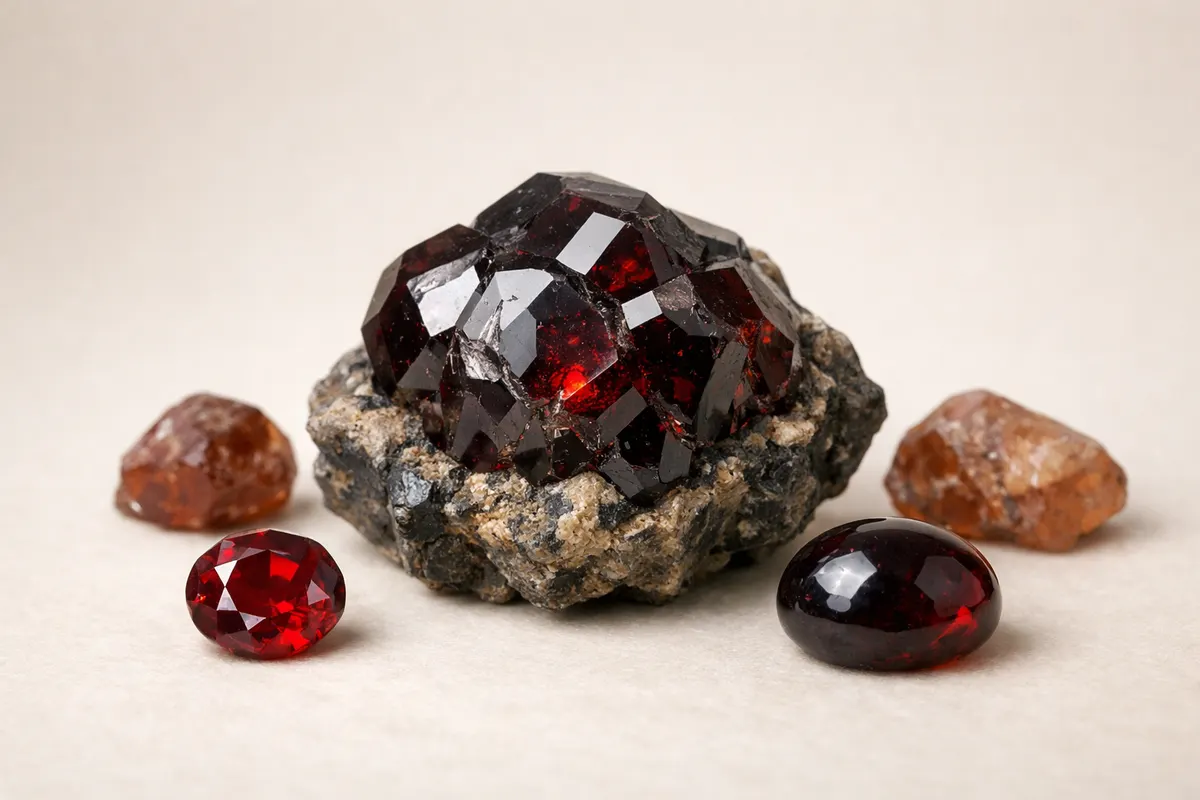
What is garnet? Composition, varieties, and jewelry uses
Garnet is a mineral group that includes almandine, pyrope, spessartine, grossular and andradite. Tsavorite is a green variety of grossular, and demantoid is a green variety of andradite. A label reading “garnet” can describe stones of several colors and compositions.
Most gem-quality garnets appear in transparent to translucent red, orange, brown, green, and rarely yellow or black. Red almandine and pyrope are the common commercial forms in older jewelry; green tsavorite and demantoid are higher-value types favored by collectors when well colored and clean.
Garnet is widely used in rings, earrings, pendants, and vintage pieces because it cuts well and often shows lively brilliance. In everyday jewelry it’s set in silver, gold, and even mixed-metal designs; in many cases, older or mass-market pieces use smaller cabochons or calibrated faceted stones.
- Family mineral: several species share the name ‘garnet’ with different chemistry and color.
- Common in jewelry: durable enough for rings and pendants but varies by species.
- Collector types: tsavorite and demantoid command higher prices when clean and well sized.
Garnet identification: How can you tell from photos?
Phone photos can reveal many reliable visual signals for garnet, even though a single image cannot prove species or authenticity. Start with color and lighting: many garnets show a uniform, saturated red-orange to brown-red without the strong pleochroism seen in tourmaline or the ruby’s deeper, cooler red.
Use a loupe or macro photo to check inclusions and internal texture. Garnets often contain granular crystals, needle-like rutile (less common), or three-phase inclusions in gem-quality stones. Air bubbles, curved flow lines, and very round gas bubbles are strong photo clues for glass or assembled imitations.
Pay attention to crystal habit where visible: garnet crystals commonly form dodecahedral faces and may show sharp facet junctions on natural broken faces. Reflections in a well-cut garnet are typically crisp and high-contrast because garnet’s refractive index is relatively high (visually, this reads as good sparkle on a faceted stone).
For a quick, photo-friendly checklist: check color uniformity, look for natural inclusions vs bubbles, note brilliance and edge crispness, and compare weight/size if you can (garnet is relatively dense). If a stone looks overly bright with curved internal features, treat glass or doublet as likely.
- Color: saturated red–orange, brown-red, or vibrant green for tsavorite/demantoid; often single-hued.
- Inclusions: granular crystals or three-phase inclusions suggest natural garnet; round bubbles suggest glass.
- Surface and facet reflections: sharp, bright reflections align with garnet’s higher refractive index.
- Density hint: garnet feels heavier than similarly sized quartz in hand or in parcel photos.
Garnet: Key facts at a glance
The table below summarizes the basic physical and jewelry-related facts that most buyers and photo-identifiers find helpful. These attributes are useful for a first-pass visual identification but do not replace gemological testing when certainty is required.
If you’re photographing a stone, include a scale, a white balance reference (plain paper), and both face-up and profile shots to capture color, transparency, and the pavilion reflection pattern.
| Attribute | Typical value | Notes |
|---|---|---|
| Composition | Nesosilicates (various X/Y cations) | Groups include almandine, pyrope, spessartine, andradite, grossular (tsavorite) |
| Hardness (Mohs) | 6.5–7.5 | Hard enough for many jewelry uses but can chip if struck |
| Specific gravity | 3.5–4.3 | Heavier than quartz; density varies by species |
| Appearance | Transparent to opaque; vitreous luster | Faceted gems show strong sparkle; cabochons are common in older pieces |
| Common settings / care sensitivity | Rings, pendants, earrings; moderate care | Avoid hard knocks; some species (demantoid) can be brittle around inclusions |
- Use multiple angles and a scale for clearer visual evidence.
- Specs help prioritize likely species (e.g., tsavorite vs. almandine) but not absolute identification.
What garnet is worth on the secondhand market
Start a resale comparison with confirmed identity and comparable completed sales. A red stone in a ring could represent much of the selling price or only a small share of it. Metal, maker, condition and how the piece is sold can matter as much as the center stone. Separate loose gems from finished jewelry before comparing prices.
Find examples with similar variety, cut, size and condition. Record the sale date, currency and any buyer premium. Asking prices alone give little information about what a buyer will pay. When a variety name materially affects the estimate, obtain a gemological identification and a valuation appropriate to the intended sale.
| Comparison | Evidence to collect | Why it matters |
|---|---|---|
| Loose stone | Verified variety, weight, cut and condition | Helps locate comparable loose-stone sales |
| Mounted stone | Setting, metal, maker and condition | The sale price covers the entire piece |
| Named green variety | Independent identification report | Color alone cannot separate tsavorite from demantoid |
| Comparable sale | Date, currency and fees | Shows what a buyer actually paid |
- Rarity and color consistency are often the largest single value drivers for garnets.
- Historical settings or designer pieces can increase resale price independently of the stone.
Lookalikes: Stones garnet is often mistaken for
Garnet is commonly confused with several red and green gems. From photos, the main lookalikes are ruby, spinel, glass, and certain tourmalines. Distinguishing traits include pleochroism, inclusion type, and the presence of curved features that indicate glass.
Ruby and spinel can share a similar pavilion reflection and red saturation, but rubies often show a cooler, more purplish red and may display silk or rutile needles under magnification. Spinel generally lacks the same dense, granular inclusion pattern seen in many garnets.
Green garnets (tsavorite and demantoid) can be mistaken for emeralds or green tourmaline. Tsavorite typically shows a cleaner, lively green without the deep hexagonal color zoning and fractures common in emerald, and demantoid can show characteristic horsetail inclusions visible in macro photos.
- Glass imitation: look for gas bubbles and curved flow lines in macro photos.
- Spinel: similar refractive behavior but usually cleaner, with different crystal inclusions.
- Tourmaline: strong pleochroism (color change by angle) helps separate tourmaline from garnet.
Care and handling for garnet jewelry
Most garnets are durable for everyday wear but benefit from common-sense care. Clean faceted garnets with warm soapy water and a soft brush; rinse and dry thoroughly. Avoid steam cleaning for stones with obvious fractures or fragile inclusions.
Ultrasonic cleaning is usually safe for clean, solid garnets but avoid it for stones with visible internal fissures or in older settings where the mounting could have weakened. Store garnet pieces separately from softer gems to prevent scratch damage, and avoid harsh acids or prolonged exposure to strong chemicals.
- Safe: warm water, mild detergent, soft brush.
- Use caution: ultrasonic if fractures or inclusions are present.
- Storage: separate compartments or soft pouches to avoid scratching.
Frequently asked questions
Garnet vs ruby: How can I tell which I have from a photo?
Ruby and red garnet can look alike in indoor light and in phone photographs. Clean views from several angles are useful for documenting the stone and its condition. A gemologist can use optical properties and magnified features to distinguish them. Verify identity before basing a sale price or an insurance decision on the label.
Can a phone photo be enough for reliable garnet identification?
A phone photo can provide strong visual clues—color, inclusion patterns, and surface reflections—that point toward garnet, but it cannot establish species or authenticity with certainty. Use macro shots, a white-balance reference, and both face-up and profile images to collect the best evidence; a gem lab or in-person gemologist is required for definitive ID and grading.
How do I approach garnet identification when preparing to sell a secondhand piece?
Record the dimensions and condition, keep any laboratory report or sales documentation, and photograph the stone and setting in neutral light. Compare recent completed sales of similar pieces. Weighing a mounted ring gives the weight of the whole object. A jeweler can advise whether the stone weight can be estimated and whether a laboratory report would help a buyer.
What visual signs should I prioritize in garnet identification photos?
Prioritize color accuracy (use daylight or a neutral white reference), macro images of inclusions, and profile shots that show pavilion reflections and facet edges. Look for natural inclusion textures (granular crystals, three-phase inclusions) versus curved bubbles or flow lines that indicate glass. These photo cues narrow possibilities quickly, though laboratory tests remain the only route to conclusive species or treatment determinations.
Related guides
Compare your photo to garnet clues with Stone Identifier - Gemalyze
After you’ve photographed color, inclusions, and profile reflections, use Stone Identifier - Gemalyze as an optional first pass to compare your images against typical garnet clues. The tool can highlight visual matches and suggest likely species, helping you decide whether a lab report or local appraisal is the next move. Start at https://stoneidentification.app/tools/gemstone-identifier and have several well-lit photos ready for the best results.
Take the next step →