
Stone Identification
Tiger's Eye: Identification, Value, and Real Examples
Practical guide to the tigers eye stone: what it is, photo-checkable ID clues, typical secondhand value ranges, and safe next steps before relying on a picture.
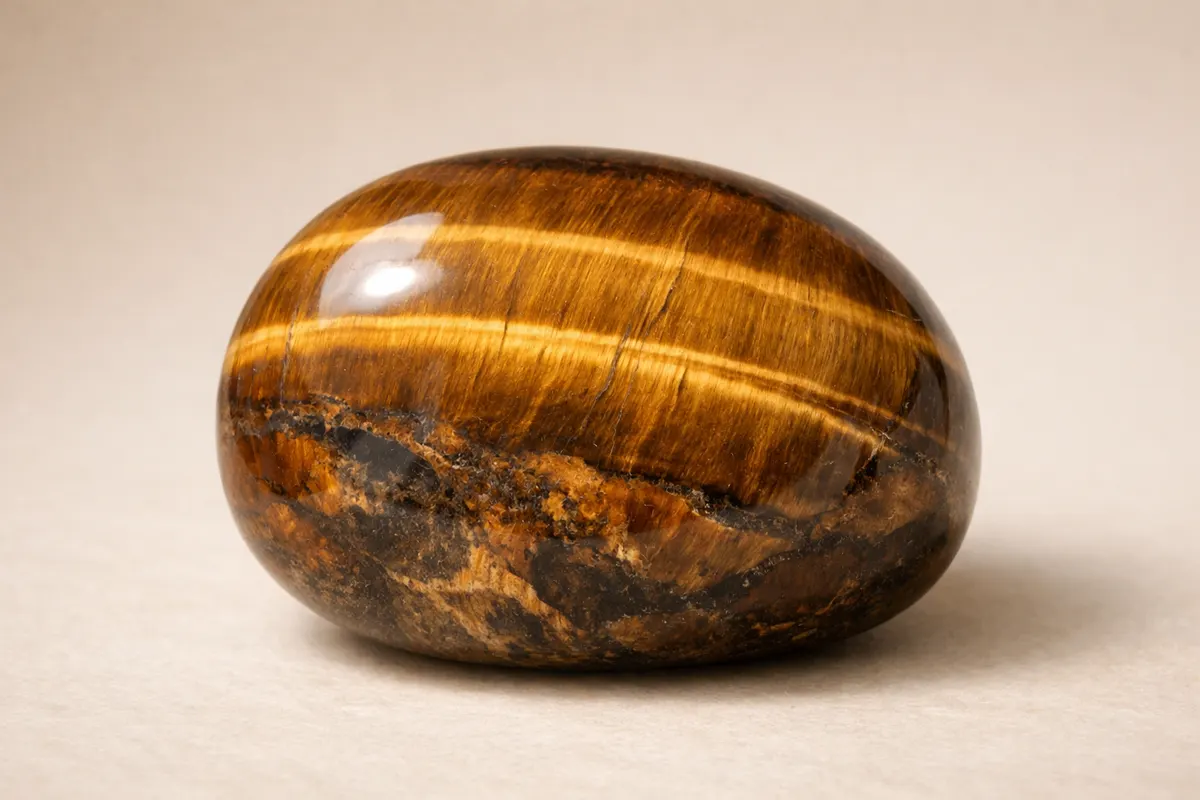
What a tigers eye stone is and where it comes from
A tigers eye stone is a chatoyant variety of quartz that shows a silky, moving band of light across fibrous, parallel structures. The effect—called chatoyancy or “cat’s eye”—comes from millions of microscopic fibers of crocidolite that were converted to silica while preserving the aligned fibrous texture. That gives tiger’s eye its characteristic golden to brown stripes and a shimmering band that slides as the stone or light moves.
Most commercial material is cut as cabochons, beads, or polished slabs to highlight the chatoyant band. Jewelry uses range from costume and fashion pieces to carved ornaments and cabochons set in rings, pendants, and bracelets. High-quality specimens with a sharp, centered eye are most often sold as cabochons because the cut maximizes the effect.
Major sources of tigers eye include South Africa, Western Australia, India, and Brazil. The stone’s appearance can vary by origin: deep golden-brown material with silky luster is common from South Africa, while some Brazilian pieces have paler tones. Knowing origin can help with provenance-based value, but visual clues and condition are the dominant factors buyers look at.
- Composition: quartz with pseudomorphous replacement of crocidolite fibers (silicified amphibole).
- Typical colors: golden brown, honey, red-brown; blue-gray hawk’s eye is the iron-oxidized variant.
- Common cuts: cabochon, beads, tumbled stones, carved items; cabochons best show chatoyancy.
How can you tell if a tigers eye stone is real from photos?
Photos can show many reliable ID clues for a tigers eye stone, but they cannot prove authenticity on their own. The most telling photographic signs are a well-defined, narrow band of moving light (chatoyancy), parallel fibrous banding visible under oblique lighting, and a silky, semi-reflective luster. Shots taken from multiple angles under a single directional light source are the most useful.
Look for a single, concentrated band of light that translates across the stone as the camera or light moves. Glass imitations and dyed jaspers often show static patterns or abrupt color boundaries rather than a smooth, reflective cat’s-eye band. A loupe or macro photo that reveals parallel striations or hairlike fibers is strong supporting evidence.
Other quick photo checks: color consistency (natural tigers eye has subtle tonal shifts, not uniform flat color), absence of visible bubbles (glass fake), and the way highlights respond—natural chatoyancy narrows to a bright stripe, whereas printed or painted patterns stay diffuse. Avoid relying on a single, low-resolution flash photo; multiple light angles and a plain background improve confidence.
- Photograph under one directional light from several angles to show the moving band.
- Include a close-up macro image to reveal fine parallel fibers or striations.
- Watch for bubbles, uniform dye, or visible seams that indicate glass or resin imitation.
- Compare the band movement to the background: a real cat’s-eye will shift smoothly with light.
Key facts and quick reference for tigers eye stone
This compact table lists the technical attributes that help identify and judge a tigers eye stone at a glance. Use these specs as shorthand when comparing photos or notes; they summarize composition, typical hardness and density, and common jewelry uses.
| Attribute | Typical detail |
|---|---|
| Composition | Silicified crocidolite (quartz replacing amphibole fibers) |
| Hardness (Mohs) | About 7 — resists scratching by steel, workable for common jewelry |
| Density | Approx. 2.64–2.71 g/cm³ |
| Optical feature | Chatoyancy: a single, silky band produced by aligned fibrous structure |
| Common cuts/settings | Cabochons, beads, carved pieces; set in rings, pendants, bracelet beads |
| Care sensitivity | Stable to normal wear; avoid strong acids, ultrasonic cleaners for older or treated pieces |
What a tigers eye stone is worth on the secondhand market
Value for tiger’s eye is driven mainly by the clarity and sharpness of the chatoyant band, color saturation, size, cut quality, and whether the stone has been treated or dyed. Condition (surface scratches, chips) and the setting type also affect resale. Below are typical secondhand ranges; these are general market observations, not appraisal guarantees.
Smaller, common beads or tumbled stones are widespread and sell for modest amounts, while a clean, eye-centered cabochon in a desirable size commands a premium. Provenance and novelty (e.g., exceptional color or a rare blue hawk’s eye) can push prices higher, but documented lab reports are needed for high-end certainty.
Remember that photos can suggest quality but rarely give definitive value. If resale is important, combine photographic inspection with physical checks—weight, luster under different lights, and a professional appraisal for expensive pieces.
| Tier | Typical secondhand range | What drives value |
|---|---|---|
| Cabochon, commercial grade | $5–$30 per carat | Moderate eye, common color, typical size |
| Good-quality cabochon | $30–$100 per carat | Sharp centered eye, attractive color, clean surface |
| Collector/high-chatoyancy pieces | $100–$300+ per carat | Exceptional single-band chatoyancy, large size, rare color |
| Beads, tumbled stones, small items | $0.50–$5 per piece or per carat equivalent | Mass-produced beads or polished stones with variable eye |
- Chatoyancy quality is the single most important visible value driver.
- Treatments (dyeing, resin stabilization) reduce typical resale value compared with untreated material.
- Settings with precious metal content will increase total item value independent of the stone.
Commonly confused with
Tiger’s eye is commonly mistaken for a few other materials that mimic banding or color. The most frequent lookalikes are hawk’s eye (the blue-gray variant of the same family), tiger iron (banded jasper/hematite mix), jasper that’s been dyed or patterned, and glass/resin imitations. Each has photographic cues you can use to separate them.
Hawk’s eye shares the same chatoyant origin but appears blue-gray and can show a subtler eye; comparing color under neutral light helps. Tiger iron shows alternating metallic and jasper bands—those iron bands tend to be opaque and metallic rather than silky; macro photos that reveal granular jasper texture next to reflective iron are diagnostic.
Glass or resin imitations often show bubbles, perfectly uniform color, or seam lines under magnification. Dyed jaspers may have abruptly saturated color zones or pooling of dye near fractures; the chatoyant stripe in real tiger’s eye is produced by aligned fibers and will narrow to a bright line under directional light, unlike a painted stripe.
- Hawk’s eye: blue-gray chatoyancy; compare color in natural light and check for silky band.
- Tiger iron: alternating jasper and metallic bands; look for granular jasper texture beside metallic seams.
- Glass/resin: visible bubbles, injection seams, or perfectly uniform color under magnification.
- Dyed jasper: abrupt color boundaries, concentrated pigment in fractures; lacks true moving cat’s-eye.
Care and handling for tigers eye stone
Tiger’s eye is relatively hard and durable for everyday jewelry but benefits from reasonable care. Clean with a soft cloth and warm soapy water; rinse thoroughly and dry. Avoid strong acids and household chemicals that can affect polish or any surface treatments.
Ultrasonic and steam cleaners can be used on many clean, untreated quartz stones, but avoid them for heavily included, fracture-filled, or glued composite pieces. Store tiger’s eye separately from harder gems like diamonds to reduce the risk of scratches to the polished surface.
If you suspect a piece has been dyed or stabilized, treat it cautiously: avoid aggressive cleaning and consult a professional before attempting restoration or deep cleaning.
- Cleaning: mild soap, soft brush, rinse, and air dry.
- Avoid extreme heat and harsh chemicals that can affect polish or treatments.
- Store wrapped or in a soft pouch to protect polished cabochons from abrasion.
Frequently asked questions
How does tigers eye identification work when I only have photos?
Photos can demonstrate key visual traits—chatoyancy (a moving band), parallel banding, color variation, and surface condition—but they cannot prove authenticity or value alone. Provide multiple high-resolution photos from several angles under directional light and a close-up macro shot to reveal fibrous texture. Use images to rule out obvious fakes (bubbles, seams, uniform dye) and to prioritize pieces for in-person inspection or professional appraisal.
Can a photo alone prove my tigers eye stone is genuine?
No — a photo can strongly suggest that a stone is tiger’s eye (if it shows the characteristic cat’s-eye band and fibrous pattern), but it cannot replace hands-on tests like hardness, specific gravity, and microscopic examination. Treat photos as a first-pass filter: they reduce the pool of plausible identifications but don’t guarantee authenticity or grade.
How much could a tigers eye stone like mine be worth on resale?
Typical secondhand ranges depend on size, cut, and the quality of the chatoyancy. Commercial beads and tumbled stones sell for modest amounts, while clean, well-centered cabochons command higher per-carat prices. Use the value table in this article as a rough guide and remember that setting, condition, and market demand affect final realized price. For higher-value items, seek a formal appraisal.
Can tigers eye be treated or dyed, and how can I spot that in photos?
Yes. Dyeing and resin stabilization occur in lower-grade material; treated stones may show unnatural uniformity of color, dye concentration near fractures, or a plastic-like surface sheen. In photos, look for abrupt color transitions, visible pooling of pigment, or a slightly plasticky reflection under oblique light. Macro images and magnification are most helpful to reveal treatment signs.
Related guides
Compare your photo to Tiger's Eye clues with Stone Identifier - Gemalyze
If you have photos of a piece, use Stone Identifier - Gemalyze on your device to compare them against the visual clues on this page—chatoyancy, fiber-like banding, and color behavior. Treat app results as a first pass: they help prioritize items for in-person checks or professional appraisal but do not replace hands-on testing or a certified report. Open the app, capture or import clear multi-angle photos under directional light, and follow the checklist to narrow possibilities before you buy, sell, or insure.
Take the next step →