
Agate vs Jasper: Bands, Opacity, Color, and Texture
Use visible clues like banding, opacity, color patterns, and texture to tell agate vs jasper apart—and learn the best next steps when photos aren’t enough.
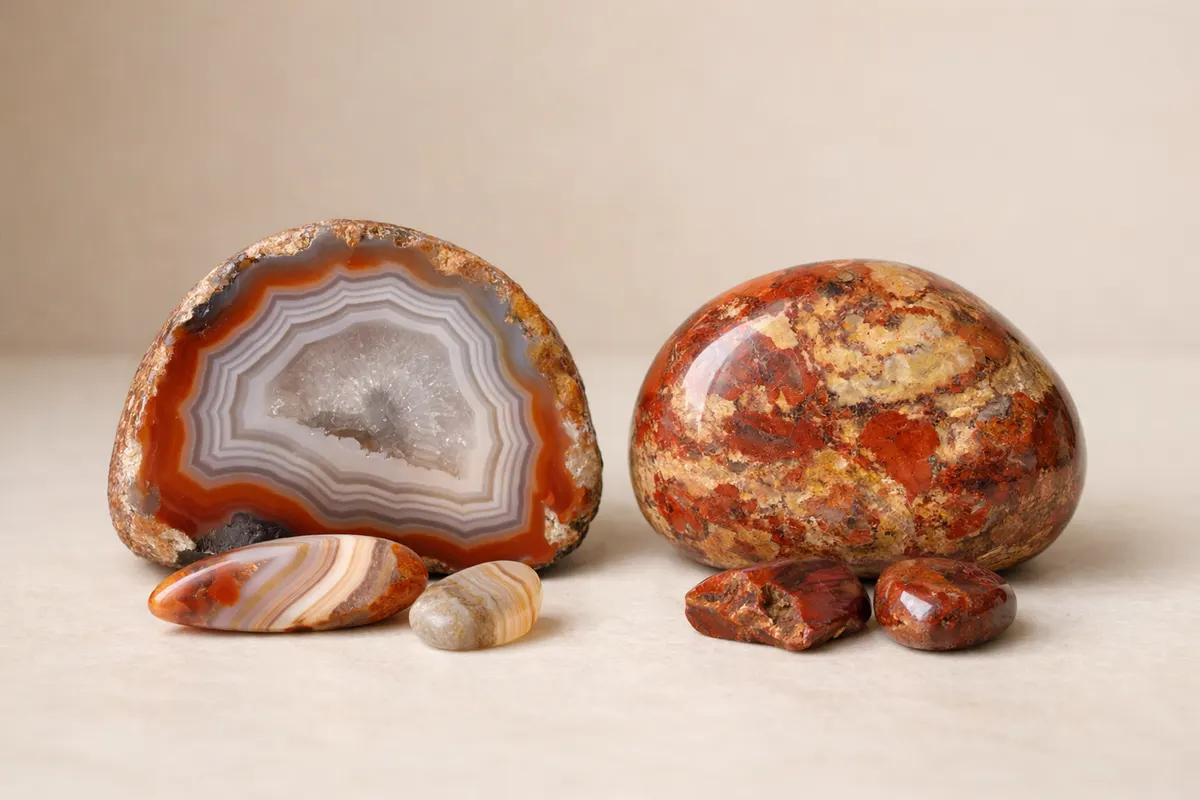
Quick visual difference: agate vs jasper at a glance
Agate and jasper are both microcrystalline forms of quartz, but the most reliable visual split is translucency versus opacity: agate commonly shows clear to semi-translucent banding, while jasper is typically opaque with solid, earthy patterns. When you hold an agate thin slice to light you often see layered concentric bands or fortifications. A jasper piece, by contrast, keeps light out and shows dense color fields, breccias, or orb-like spots rather than true bands.
Color alone is misleading because both stones are dyed, heat-treated, or colored by iron and other impurities in nature. Use color patterns together with how the material transmits light: a photo with backlighting or an edge shot that reveals translucency will often separate agate from jasper faster than relying on hue or saturation.
Texture and surface appearance help too. Agate often polishes to a glassy sheen and reveals smooth band boundaries; jasper usually looks more granular or matte in unpolished specimens and may have visible matrix, fossil fragments, or flow structures. Keep in mind that cut and polish hide some of those clues, so context—where the stone came from and how it was cut—matters for a confident visual ID.
- Agate: banded, semi-translucent in thin edges, glassy polish.
- Jasper: opaque, earthy or spotted patterns, often granular texture.
- Best photo clues: edge translucency, concentric bands, and internal pattern continuity.
Direct comparison: agate vs jasper features and photo confidence
This comparison highlights the everyday visual checks you can do from photos and what each clue realistically supports. Use the table as a quick reference during image review: compare the pattern, test translucency visually, and note the photographer’s lighting and angle.
Photo confidence assesses how likely that particular visible clue will point reliably to agate or jasper without hands-on testing. Even high-confidence photo clues still benefit from one or two follow-up images—especially backlit or edge shots—to avoid misreads caused by polish, dye, or camera exposure.
| Feature | Typical agate | Typical jasper | Photo confidence | Next photo/test to try |
|---|---|---|---|---|
| Bands and pattern | Concentric/fortification bands, thin layering | Blocky patches, orbicular spots, breccia; rarely true bands | High if bands continuous and not surface-only | Edge/backlit shot to show band depth |
| Opacity / translucency | Translucent to semi-translucent at edges | Opaque throughout | High with backlight or edge photos | Hold to light or take backlit photo |
| Color and hues | Varied—can be bright or pastel; bands often contrast | Earth tones, green/brown/red; solid or mottled | Low alone (many stones dyed or heated) | Compare unpolished surfaces or matrix |
| Surface texture & luster | Glassy polish; smooth band boundaries | Dull to waxy; granular or brecciated texture | Medium—polish can mask texture | Macro/close-up of an unpolished edge |
| Common lookalikes | Chalcedony slices, dyed quartz, agate-filled seams | Rhyolite, jasperized wood, other opaque silicates | Medium—look for context and pattern | Contextual photos (source rock, matrix) and scale |
- Aim to get an edge or backlit photo when possible; that single extra shot raises ID confidence more than any color-correction edit.
- If the piece has clear concentric bands and passes a translucency check, agate becomes the more likely ID; total opacity with granular texture favors jasper.
When to call something agate and when to call it jasper
Use 'agate' when the stone clearly shows internal banding and transmits light at its thinner edges. In markets and hobby contexts, calling a specimen agate is appropriate if those bands are intrinsic (running through the material) rather than just surface weathering or dye lines. Agate names are often specific—fortification agate, plume agate, or eye agate—so if you see diagnostic patterns like lace, plume, or eye structures, agate is the practical label.
Use 'jasper' when the material blocks light, shows consistent opacity, and presents earthy, granular patterns or inclusions such as fossil fragments or iron staining. Jasper is commonly named for visual motifs too—picture jasper, ocean jasper, or brecciated jasper—but the unifying feature for everyday identification is opacity plus a cohesive, often chunkier internal texture.
In a sale, appraisal, or field-note context, prefer conservative labeling: say 'likely agate' or 'probable jasper' when photo clues point one way but you lack a backlit shot or physical tests. That phrasing keeps expectations realistic and signals that further examination would be useful before high-stakes decisions like buying, selling, or using the stone in jewelry.
- Label as agate when you see intrinsic banding and translucency at the edge.
- Label as jasper when the piece is opaque with dense, earthy patterning or matrix.
- Use cautious language—'probable' or 'consistent with'—if photos lack scale or lighting context.
Why agate vs jasper is easy to mix up
Many confusions come from treatments and how specimens are cut. Dyed chalcedony or heat-treated slices can show faux bands or unusually bright colors that imitate either agate or jasper. Polishing erases surface texture, and cabochon cuts hide edge translucency, so even experienced eyes can be fooled when only a single, well-polished face is visible in a photo.
Pattern overlap also causes mistakes. Some jaspers—especially orbicular or landscape types—create round or layered motifs that mimic agate banding at a glance. Conversely, thin translucent jasper seams can be mistaken for agate when photographed against a bright background. Lighting angle and camera exposure play a big role: overexposure may wash out internal structure, while underexposure hides translucency.
Field context and matrix information are often missing in online photos, yet they matter. Agate tends to form as fillings in cavities (geodes or vesicles) and often keeps a rounded outer rind; jasper commonly occurs as solid, massive nodules or replacements in sedimentary or volcanic rock. Without that context, pattern and color are treated as signals they’re not—so confirmations that don’t rely solely on color or a single photo are essential.
- Polish and cut hide translucency—ask for an edge or backlit image.
- Dyed or treated material can create misleading colors and bands.
- Orbicular patterns and breccias can look agate-like in flat photos.
- Always consider scale, context, and multiple photos before deciding.
Verification steps before you act on an agate vs jasper ID
Start with better photos. Request or take at least three images: a face shot under neutral light, an edge/backlit shot to check translucency, and a close-up (macro) of texture or any matrix. These three angles answer most visual questions: bands vs patches, light transmission, and surface grain or inclusions. For collectors or sellers, also include a shot with a ruler or coin for scale.
Do a non-destructive quick check if you have the piece in hand: hold a thin edge to a bright light or sunlight (without heating or stressing the stone) and inspect the edge for light transmission. Use a 10x loupe to look for fine fibrous banding or drusy cavities—agate often shows smooth, continuous band boundaries under magnification while jasper displays more granular specks or clastic fragments.
Avoid destructive or risky tests unless the material’s value justifies them. Hardness scratches and acid tests can damage surfaces and reduce value. If you need higher confidence—say for a purchase, resale, or appraisal—seek a professional gemological check that can run refractive index or specific gravity tests. These lab methods separate microcrystalline quartz subtypes reliably, but photo-based checks should be exhausted first.
Use digital tools as a first pass. The Stone Identifier - Gemalyze mobile app can help narrow possibilities after you collect the recommended photos, but treat its results as research notes rather than definitive proof. If the app flags a match, follow up with the visual checks described here and, for valuable specimens, with a hands-on gemologist or lab report.
- Photos to take: face, edge/backlit, close-up macro, and a scale reference.
- In-hand checks: edge translucency test (no heat), loupe examination for grain/banding.
- When in doubt on value or authenticity, choose professional gemological testing over risky home tests.
- Use Stone Identifier - Gemalyze after gathering photos; don’t treat app suggestions as final verification.
Related guides
Try a guided photo check with Stone Identifier - Gemalyze
After you’ve taken face, edge/backlit, and macro photos, use Stone Identifier - Gemalyze on your phone as a practical next step to narrow candidates. Treat the app’s suggestions as research notes to guide further checks, not as final verification. If a match looks valuable or uncertain, pair the app result with the visual tests above or consult a gemologist for lab-grade confirmation.
Take the next step →Frequently asked questions
Can a single photo reliably tell agate from jasper?
A single photo can suggest one or the other but rarely proves it. Face shots without edge or backlighting can hide translucency and polish can mask texture. Ask for an edge/backlit photo plus a macro close-up; those two additions raise confidence dramatically. For high-value decisions, follow up with hands-on or lab testing.
What’s the best quick test I can do at home to check translucency?
Hold the stone’s thin edge up to a bright light or sunlight and look for a glow through the material. Agate will often let light pass at edges or through slices; jasper stays dark. Don’t apply heat, pressure, or solvents, and avoid prolonged sunlight that can fade dyed stones.
Are there common lookalikes I should watch for?
Yes. Dyed chalcedony and treated quartz slices can mimic agate banding; rhyolite and some silicified sedimentary rocks can look like jasper. Petrified wood or jasperized fossils may have similar earthy colors. Check for matrix, fossil fragments, or flow texture and use multiple images to reduce misidentification risk.
When should I get professional testing instead of relying on photos?
Seek professional gemological testing when the stone’s monetary, historical, or emotional value justifies it—commonly before high-value purchases or sales or when the ID affects safety or provenance. Lab tests that measure refractive index, specific gravity, or run microscopic inclusion analysis provide the decisive evidence photos cannot.