
Jade vs Serpentine: Color, Texture, Luster, and Weight Clues
Compare jade vs serpentine using color, texture, luster, and heft clues you can check in photos and in hand before seeking lab confirmation.
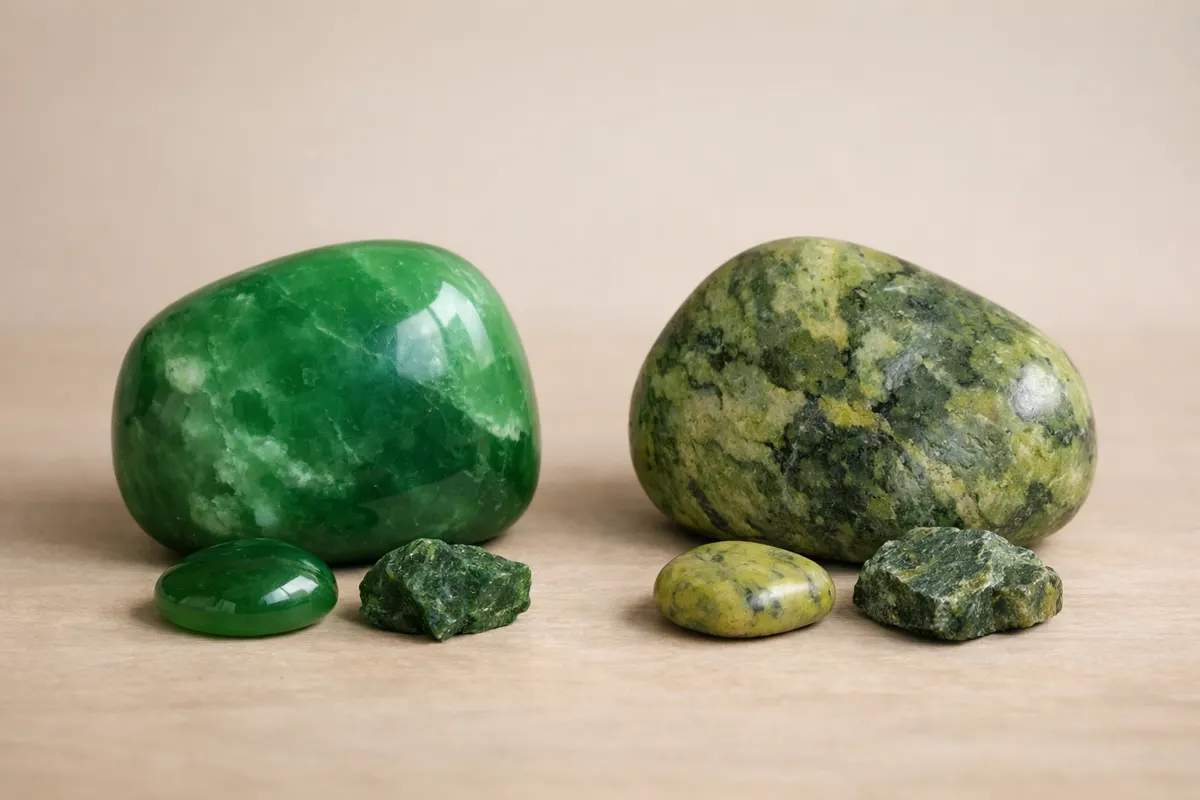
Quick answer: jade vs serpentine at a glance
Jade vs serpentine: in photos the fastest practical difference is texture and luster. True jade (nephrite or jadeite) tends to show a denser, more even, often waxy-to-glassy sheen and finer interlocking fibrous structure; serpentine usually looks softer, with fibrous or scaly texture and a more satin, oily, or waxy surface that can appear duller in direct light.
Color overlap is large—both can be green, yellow-green, or mottled—so color alone rarely proves a match. Instead prioritize visible clues: very even, translucent patches with a smooth, oily gloss often point toward jade; patchy, scaly surfaces, vein-like seams, or a 'soapy' matte finish point toward serpentine or related minerals.
Weight and heft are helpful in hand: jadeite and nephrite are noticeably heavier than most serpentines because their specific gravity is higher. In photos you can only infer this from context (how the piece sits in a hand or the apparent thickness), so treat any weight guess from images as low-confidence.
Bottom line: use luster and texture from photos for a first-pass suggestion, then follow a short verification path before you rely on the ID for a purchase or valuation.
- High-confidence photo clue for jade: fine, even translucency with a smooth, glassy or oily sheen and few surface scaly textures.
- High-confidence photo clue for serpentine: scaly/fibrous surface, duller satin or soapy luster, and visible veinlets or layered breakdown.
- Low-confidence clues: color alone, carved surface sheen after polishing, or small, low-resolution photos without scale.
Side-by-side clues: jade vs serpentine
A crisp table helps you compare practical photo clues, how reliable each clue is from images, and what to do next. Treat the 'photo reliability' column as a guide to how much faith to place in that observation when you only have pictures.
Use the table below while inspecting close-up photos: look for described textures, glints of translucency, and natural fractures. After the table, read the short follow-ups where I explain a couple of common photo traps to avoid.
| Property | Typical jade (nephrite/jadeite) | Typical serpentine | How reliable from photos | Quick next check |
|---|---|---|---|---|
| Color range | Apple green to deep green, white/imperial hues, even tones | Yellow-green, olive, mottled greens, brownish zones | Low — many overlaps | Compare with texture and luster, not color alone |
| Texture & internal pattern | Fine, interlocking fibrous or granular texture; often smooth at macro scale | Fibrous, scaly, or layered, sometimes visible foliation or veinlets | High — visible in good close-ups | Zoom in on edge or broken surface photos |
| Luster | Waxy to oily or sub-vitreous; can be glossy on polished faces | Soapy, dull-satin, or oily but usually less glassy | High — light reflection patterns differ | Observe reflections under diffuse light |
| Translucency | Often translucent in thinner areas (especially jadeite) | Usually more opaque, thin edges may transmit weak light | Medium — needs good lighting | Backlit photos or thin-edge photos help |
| Heft / specific gravity | Relatively heavy (jadeite ~3.2–3.4; nephrite ~2.9–3.1) | Lighter (typical serpentine ~2.5–2.7) | Low from photos | Compare scale in-hand photos or ask for weight |
When to suspect jade or serpentine
Knowing which stone to suspect first saves time. If you see a polished, translucent green carving with a smooth, glassy sheen and minimal scaly texture, start with jade as the leading hypothesis. This is especially true when the piece is thin at the edges or the light seems to pass through veins in the stone.
If the object is matte or satin, shows clear fibrous breakdown, looks chalky in worn areas, or has irregular surface patches and veinlets, serpentine is the better starting point. Serpentine is commonly used for carvings and beads that imitate 'jade' in lower-cost markets, so expect trade names or confusion in descriptions.
For jewelry items where weight and cold-to-touch feel are possible to check, weigh the piece or note how heavy it looks relative to its size in hand photos. A compact, heavy piece leans toward jade; a similarly sized lightweight object leans toward serpentine or other softer green minerals.
When you need extra context, reference a few practical resources: if you want to broaden field clues for dark stones, see the Black Stone Identification guide (https://stoneidentification.app/blog/black-stone-identification). For photo-based authenticity checks that cover fakes and surface treatments, the Real vs Fake Gemstones article is a useful next read (https://stoneidentification.app/blog/real-vs-fake-gemstones).
- Suspect jade: polished, glassy sheen, even color zones, thin-edge translucency, and heavy feel.
- Suspect serpentine: scaly/fibrous patterns, soapy/duller luster, patchy color, signs of weathering or chalky wear.
- When uncertain: ask for high-res close-ups of edges, fractures, and the piece in hand for scale.
Why jade and serpentine are often mixed up
Trade names and regional terms cause a lot of confusion. The word 'jade' is often applied loosely in markets to any attractive green stone; serpentine varieties like bowenite have historically been sold as 'New Zealand jade' or 'Canadian jade' in tourist and souvenir contexts. That naming practice creates persistent misidentifications in listings and informal appraisals.
Polishing and surface treatments change how both minerals look in photos. A well-polished serpentine bead can mimic the oily gloss of nephrite, and wax or oils used on carvings enhance translucency and disguise fine scaly texture. Conversely, poor polishing on jade can make it look dull and more serpentine-like.
Microscopic structure matters: nephrite is a felted interlocking mass of fibrous amphiboles and jadeite is a granular pyroxene aggregate; serpentine is usually platy or fibrous and breaks differently. These structural differences produce subtle but observable clues in good macro photographs—look for layered cleavage, granular sparkle, or fibrous streaking.
Finally, lookalikes extend beyond serpentine. Chrysoprase, prehnite, and dyed chalcedony appear in similar color bands; each has its own textural cues. When sellers use broad labels, keep a skeptical baseline and rely on combined clues (texture, luster, translucency, and context) rather than a single visual trait.
- Naming confusion: bowenite and other serpentines are sometimes labeled as 'jade' in trade.
- Surface treatments: waxes and oils can mask texture differences and make serpentine look like jade.
- Other lookalikes: chrysoprase and dyed chalcedony mimic green color but differ in translucency and luster.
Verification path
Start with non-destructive checks you can do from photos or in-hand without harming the piece. Request high-resolution close-ups of edges, fractures, and the back or an unpolished section; ask for a photo with the piece held next to a known object for scale. Backlit shots of thinner areas (lamp behind a pendant or bead) are particularly revealing for translucency.
If you have the item in hand, compare heft against a similarly sized stone. Ask the seller for weight in grams. Small but consistent differences in weight often separate jadeite/nephrite from serpentine. Avoid household hardness tests that scratch the surface; a knife test can damage the object and reduce value or void some sellers' return policies.
For higher confidence without destructive testing, consider polarized light images, a simple streak test done on an unnoticeable surface (if the owner agrees), or a handheld refractometer if available. When money or authenticity is on the line, the most reliable non-destructive option is a professional gem lab report or a qualified gemologist's inspection.
Use Stone Identifier - Gemalyze as a practical next step after you gather your photos and notes: scan or photograph the item in the app, treat suggested matches as a research starting point, and then follow with in-person checks or lab verification if the result matters financially. Do not treat app suggestions as definitive proof of identity or value.
- From photos: request close-ups of edges, backlit thin-edge shots, and a scale reference.
- In hand: compare weight, cold-to-touch feel, and observe luster under diffuse light.
- Avoid destructive: do not scratch, file, or apply acids to test identity—these can damage value.
- To be certain: seek lab testing (e.g., gemological institute) or a qualified gemologist’s report.
Related guides
Use Stone Identifier - Gemalyze after your visual checks
After you’ve taken close-up and backlit photos and noted texture, luster, and weight clues, use Stone Identifier - Gemalyze on your iOS device to get a structured suggestion and supporting visual matches. Treat app results as research notes—helpful for narrowing options but not a substitute for in-person inspection or a lab report when authenticity or price matters.
Take the next step →Frequently asked questions
Can I reliably tell jade from serpentine from a single photo?
A single photo can give useful first-pass clues—texture, luster, and translucency are the most informative—but it rarely gives a definitive ID. Low-resolution images, heavy polishing, or treatments reduce confidence. Treat any photo-based ID as provisional and follow up with additional photos (edges, backlit thin sections, and scale) or an in-person verification if the piece is valuable.
Is serpentine ever sold as jade?
Yes. Some serpentine varieties, notably bowenite, have been sold as 'jade' in tourist markets and informal trade. Sellers sometimes use 'jade' as a marketing term for any green ornamental stone. Always check texture and luster evidence and ask for provenance or lab reports when authenticity affects price or sentiment.
How much heavier is jade than serpentine?
Typical specific gravity ranges: jadeite around 3.2–3.4, nephrite about 2.9–3.1, and serpentine roughly 2.5–2.7. That difference is noticeable in hand—jade feels denser for the same volume—but weight is hard to judge from photos alone. Asking for a gram weight or comparing how the piece sits in a hand photo gives a stronger hint than guessing by sight.
Should I perform a scratch test to check hardness?
No—avoid scratch tests on finished jewelry or carvings. A scratch or knife test can permanently damage the object and lower value. For hardness-related clues, prefer non-destructive observations (edge chips, fracture patterns) or request a professional evaluation. When in doubt and value is significant, a lab report is the safest route.