
Gemstone Identification
Raw Jade: Identification, Value, and Real Examples
Learn how to recognize raw jade from photos, what visual clues matter, and realistic secondhand value tiers. Practical checks, lookalikes, and next steps.
What raw jade is and where it comes from
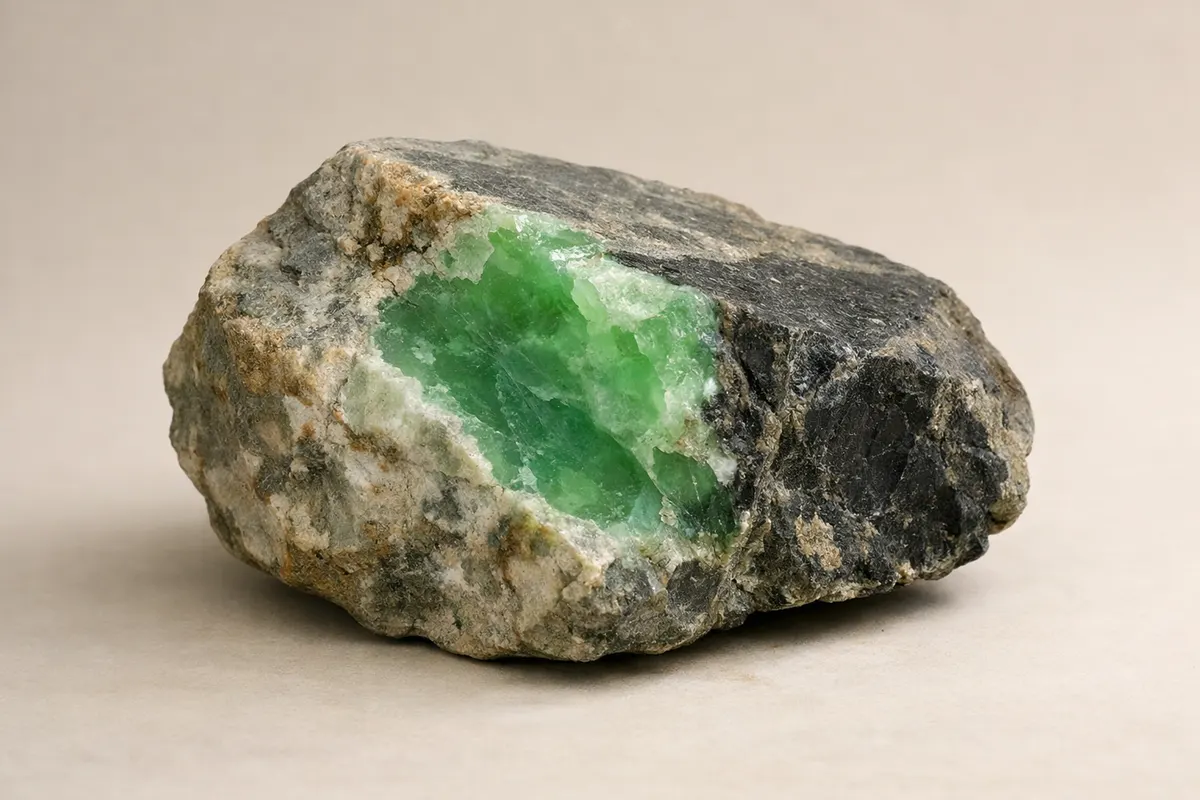
Raw jade is the uncut, unpolished material—usually pieces of nephrite or jadeite—removed from rock or boulders and sold as rough or partially tumbled fragments. In jewelry and carvings the finished product can look very different from rough samples, so photos of raw jade need careful visual interpretation.
Chemically and structurally, jade is two different minerals: nephrite (a fibrous amphibole aggregate) and jadeite (a pyroxene mineral). Both can form in a range of green tones, but they differ in texture, translucency, and typical market value. Provenance matters: historically important sources include Myanmar for high-grade jadeite and British Columbia, New Zealand, and parts of China for nephrite.
In practice, raw jade shows a mix of weathered outer surfaces, fresh fracture surfaces, and attachment remnants from host rock. Collectors look at color saturation, translucency at thin edges, and internal structure to gauge potential. Remember that a photo can suggest these traits but cannot replace lab confirmation.
How can you tell if raw jade is in your photo?
Start with lighting and scale: use a steady, well-lit photo (diffuse daylight is best) and include a size reference. Raw jade often shows a combination of waxy to greasy luster on broken faces and a more weathered, dull rind on exposed surfaces. Look for fibrous or granular texture where the stone breaks.
Check translucency at thin edges or held to light. Jadeite can be notably translucent in higher grades; nephrite tends to be more waxy and less glassy. Even a small window of light through a thin flake can be a strong visual clue that you are looking at a true jade material rather than a common imitation.
Use simple photo checks that a phone can capture: a close macro of the broken face to reveal interlocking fibers or granular crystals, a shot at an angle to capture luster, and a scale photo. If you can, include one image with a white background and neutral color balance to judge hue accurately.
Simple household checks mentioned in photos or captions can help narrow possibilities but not prove identity: heft (jade feels dense for its size), a non-magnetic response, and the absence of obvious glue or dye lines. When an image shows uneven, saturated green with surface absorption or bubbling, treat dyed impostors as likely.
- Photo checklist: diffuse daylight, scale object, macro of a broken face, thin-edge translucency shot.
- Visual clues to note in images: waxy/greasy luster, interlocking fibrous texture, even color zones without paint-like streaks.
- Red flags in photos: surface bubbles, chalky color, visible dye lines, or too-light weight relative to size.
Key facts and identification specs for raw jade
A compact table below summarizes the core physical attributes and the photo clues most useful for rough pieces. These are practical, observable traits; laboratory methods are required for definitive identification.
| Attribute | Raw jade (typical) | Photo clues |
|---|---|---|
| Composition | Nephrite (amphibole) or jadeite (pyroxene) | Fibrous vs granular internal texture visible on broken faces |
| Hardness | 6–6.5 (nephrite) to 6.5–7 (jadeite) | Resists light scratches from steel; sharp edges stay crisp in macro shots |
| Luster | Waxy to greasy polish on broken faces | Soft satin/greasy reflection in angled light |
| Typical colors | Range of greens, white, gray, lavender (jadeite); darker greens and creams (nephrite) | Even, layered green zones; avoid paint-like saturation |
| Care sensitivity | Stable; avoid harsh acids and ultrasonic cleaners | Surface pitting or etching visible after improper cleaning |
What raw jade is worth on the secondhand market
Resale values for raw jade vary widely and depend primarily on type (nephrite versus jadeite), color saturation, translucency, size, and whether the piece is suitable for carving or gem cutting. These are typical secondhand tiers to orient expectations; they are not appraisals.
Market drivers include whether the piece shows potential for high-translucency material, whether the color is an in-demand hue (vivid emerald-green jadeite is rare), and provenance notes that buyers value. Treatments such as dyeing or impregnation reduce value and can often be visible in detailed photos.
| Tier | Typical range (USD) | What drives it |
|---|---|---|
| Low-quality rough | Under $50–$200 | Common nephrite fragments, heavily weathered, dyed or porous pieces |
| Entry carving/mid-grade | $200–$1,500 | Larger pieces with decent color and workable texture; useful for small carvings |
| High-grade raw (jadeite) | $1,500–$15,000+ | Translucent, saturated green jadeite rough suitable for cabochons or larger carvings |
| Exceptional/collector | Tens of thousands and up for single pieces | Imperial green jadeite, strong translucency, provenance and large gem-quality masses |
Stones often mistaken for raw jade and how to tell them apart
Several minerals and altered rocks can look like raw jade in photos. The most common lookalikes are serpentine, aventurine, green jasper, and dyed chalcedony or quartz. Each has visual cues you can spot in images to help separate them from jade.
Use close-up photos of broken faces, angle shots for luster, and thin-edge translucency images to catch these differences. When a photo shows flaky cleavage, sparkling mica, or obvious particle sparkle, the material is likely not true jade.
- Serpentine: softer, often more waxy-to-greasy but can show serpentine-specific veining; see Jade vs Serpentine: Color, Texture, Luster, and Weight Clues for a focused comparison.
- Aventurine: visible spangled reflections from mica platelets—sparkle on broken faces usually rules out jade.
- Green jasper / chalcedony: more glassy luster and a more homogenous, often less fibrous internal structure in macro photos.
- Dyed or stabilized materials: uneven color penetration, dye lines near cracks, or overly fluorescent hues in photos are warning signs.
Care and handling for raw jade fragments
Raw jade is generally durable compared with many gemstones, but rough surfaces and fracture zones can trap dirt and damage. Handle pieces by their edges, keep them wrapped in soft cloth, and avoid exposing rough faces to household acids or strong detergents that can alter surface appearance.
If you plan to store rough material, avoid prolonged contact with metals that might stain or chemicals that could reveal treatments. For potential carving or sale, keep provenance notes and any photographs of untreated surfaces to preserve the piece’s visual record.
When cleaning for photos, use a soft brush and warm, mild soapy water, then rinse and dry carefully. Do not use ultrasonic cleaners on fragile or fractured rough without professional advice.
- Store wrapped separately to avoid scratches or staining.
- Clean gently with soft brush and mild soap; dry thoroughly before photographing.
- Avoid heat or strong chemicals that could reveal or damage treatments.
Frequently asked questions
How to identify raw jade when I only have a phone photo?
Start with multiple well-lit photos: macro of a fresh fracture, an angled shot for luster, and a thin-edge translucency photo. Note waxy or greasy luster on broken faces, fibrous or granular internal texture, and even color zoning without paint-like streaks. Include a size reference in one image. These clues narrow possibilities but cannot replace lab testing; if photos look promising, the next steps are in-person density checks, polarized-light microscopy, or a gem lab report.
Nephrite vs jadeite: How can I tell which type my rough piece is from pictures?
In photos, nephrite often shows a more fibrous, interwoven texture and a waxier appearance, while jadeite can appear more granular with higher potential translucency and a glassier sheen. Color ranges overlap, but vivid emerald greens and high translucency point toward jadeite. Photographs can suggest which group a piece belongs to, but density measurements and lab tests are required for reliable classification.
Can I estimate the value of a raw jade piece from photographs alone?
You can form a cautious resale estimate from photos by judging type, color saturation, translucency, and size, but photographs alone are often insufficient for firm pricing. Surface treatments, dyeing, and internal fractures can be hard to detect in images. Treat any photo-based estimate as provisional and consider in-person inspection or a lab report before relying on a value for sale or insurance purposes.
What should I do next if my photos look like raw jade?
If photos show strong jade clues, document everything—clear photos, measurements, and provenance notes—and consider a two-step verification: a pragmatic in-person check (specific gravity, heft, and a loupe inspection) followed by a lab report if you need a definitive ID or a formal valuation. As a first pass, you can also compare your images to reference guides such as the site's Gemstone Identification visual guide or use an identification tool to prioritize which pieces warrant further testing.
Related guides
Compare your photos with Stone Identifier - Gemalyze
If the photo clues above match your piece, use Stone Identifier - Gemalyze as an optional first pass to compare your images against the raw jade visual checklist. The tool can highlight likely matches and suggest which next checks (density measurement, loupe shots, or lab testing) will be most useful. For the best results, submit clear macro and thin-edge photos; the app helps prioritize which fragments are worth formal testing. Get started at https://stoneidentification.app/tools/gemstone-identifier.
Take the next step →